The Complete Off-Grid Van Power System: A Beginner’s Guide to Battery Banks, Power Consumption, and Renewable Energy on Wheels
Living in a van means you are responsible for your own electricity. There is no grid to plug into when you are parked on a forest service road or beside a river in the mountains. Everything you use, your fridge, your lights, your laptop, your phone, runs off a self contained power system that you build and manage yourself.
That might sound intimidating at first. But once you understand the basics, it is actually pretty simple. This guide is written for complete beginners. We will cover how off-grid van power systems work, what a battery bank is and how to build one, how to track and reduce your power consumption, and how renewable energy fits into life on the road.
Understanding Off-Grid Electricity
In your home, electricity comes from the grid, a massive network of power plants and transmission lines. You plug something in and power just appears. The utility company tracks your usage and sends you a bill.
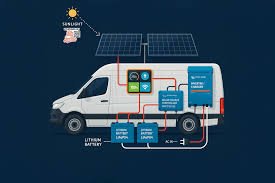
In a van, you are your own utility company. You generate electricity, usually from solar panels, store it in a battery bank, and use it through your devices and appliances. You track your own usage with a battery monitor, and when you run low, you either generate more or reduce consumption.
This self contained system is called an off-grid power system. It is the same concept used in remote cabins, sailboats, and tiny homes, just miniaturized for a vehicle. According to Natural Resources Canada, off-grid energy systems are becoming increasingly common across the country, from rural homesteads to mobile living setups.
Key Concepts to Understand
Volts measure electrical pressure. Most van systems run on 12V DC, just like your car battery. Some larger builds use 24V or 48V for better efficiency.
Amps measure the flow rate of electricity. When you pull more power, more amps flow through the system.
Watts measure the amount of power being used or produced at any given moment. Watts equal volts multiplied by amps.
Watt-hours measure energy used or stored over time. A 100W device running for 10 hours uses 1,000 watt-hours, which is the same as 1 kilowatt-hour.
Amp-hours measure battery capacity. A 100Ah battery at 12V stores 1,200 watt-hours of energy.
Get comfortable with these units. You will use them constantly when managing your van power system.
What Is a Battery Bank?
A battery bank is simply one or more batteries wired together to store electrical energy. It is the heart of your van’s power system and the central reservoir that everything flows in and out of.
Solar panels charge your battery bank. Your appliances draw from it. When the bank is full and the sun is shining, the charge controller stops the flow so you do not overcharge. When it is low, you either charge it from solar, driving, or shore power, or you reduce your consumption until it recovers.
Battery Bank Size
Battery banks are measured in amp hours. Common van setups in Canada use the following as a general guide.
A 100Ah bank is a minimal setup that works fine for a phone, lights, and a small fan but gets tight if you have a fridge running. A 200Ah bank is a solid starting point for most van lifers running a fridge and a laptop. A 300 to 400Ah bank is comfortable for full-time living, working remotely, or two people sharing a van.
Keep in mind that if you are using lithium batteries, you can safely use 80 to 100 percent of the rated capacity. If you are using AGM batteries, stick to 50 percent. So a 200Ah lithium bank gives you roughly 160 to 200Ah of usable power, while a 200Ah AGM bank gives you only about 100Ah usable.
Building Your Battery Bank
Parallel wiring is the most common approach for van setups. You connect multiple batteries positive to positive and negative to negative. The voltage stays the same at 12V but the capacity adds up. Two 100Ah batteries wired in parallel give you 200Ah at 12V.
Series wiring connects the positive of one battery to the negative of the next. The capacity stays the same but the voltage doubles. Two 12V 100Ah batteries wired in series give you 24V at 100Ah.
Most van builds use parallel 12V banks. If you are building a 24V system for better efficiency with larger inverters, use batteries wired in series.
One important rule: only connect batteries of the same type, brand, model, and age in a bank. Mixing old and new batteries, or AGM with lithium, causes serious problems and shortens battery life.
Tracking and Reducing Power Consumption
The biggest mistake new van lifers make is not knowing how much power they are actually using. They install a solar system, run it for a few days, and wonder why the battery keeps dying.
Knowing your power consumption and managing it well is the difference between a system that works and one that constantly frustrates you.
Use a Battery Monitor
A battery monitor measures the current flowing in and out of your battery and keeps a running tally of your state of charge. Think of it like a fuel gauge for your battery bank.
The Victron BMV-712 is the gold standard. It has Bluetooth, it is accurate, and it is easy to use, running around 150 to 180 CAD. The Renogy Battery Monitor is more affordable and works well at 60 to 100 CAD. The Victron SmartShunt has no display and uses a phone app instead, and it is very popular at 100 to 130 CAD.
A battery monitor shows you your current state of charge as a percentage, how many amps are going out, how many amps are coming in from solar, and historical data on how much you have used and how efficiently.
Without a monitor, you are guessing. With one, you know exactly where you stand at all times.
Know Your Biggest Power Consumers
Not all devices draw the same amount of power. Understanding which ones consume the most helps you make smarter choices every day.
High consumption devices need careful management. A 12V compressor fridge running at 30 to 60W average around the clock uses 700 to 1,400 watt-hours per day. A laptop uses 45 to 100W while working. A diesel heater fan runs at 10 to 40W for hours at a time. An inverter left on standby draws 5 to 20W the entire time it is switched on.
Medium consumption devices include LED lights at 5 to 20W total, a 12V fan at 15 to 50W depending on speed, a water pump at 60W that only runs for seconds at a time, and phone charging at 10 to 20W.
Low consumption devices include USB charging at 5 to 10W per device and small Bluetooth speakers at around 5 to 10W.
The fridge is the single biggest factor in most van builds. It runs 24 hours a day and its power draw directly determines whether your solar system can keep up.
Tips to Reduce Power Consumption
Pre-cool your fridge before a trip. It uses more energy bringing food down to temperature than it does maintaining it.
Insulate your van well. Better insulation means your fridge and heater work less, and less work means less power drawn from your battery bank.
Use LED lights everywhere. LEDs use 80 to 90 percent less power than incandescent bulbs. This is one of the easiest wins in any van build.
Turn the inverter off when you are not using it. An inverter sitting idle draws 5 to 20W. Over 24 hours that adds up to 120 to 480 watt-hours of wasted energy.
Charge your devices during peak solar hours. Run your laptop and charge your phones while the sun is strong and your battery is already full. This reduces the net draw on your bank when it matters most.
Cook on propane instead of electric. An induction cooktop can draw 1,000 to 1,800W, which is enormous for a van system. A small propane stove uses zero electricity and is the smarter choice for most van lifers in Canada.
Renewable Energy Sources for Van Life
Solar is the primary renewable energy source for van life, but it is not the only one. Understanding all your options lets you build a more resilient system that handles whatever Canada throws at you.
Solar Power
Solar panels convert sunlight into DC electricity. They are silent, maintenance-free, and produce free energy whenever the sun is shining.
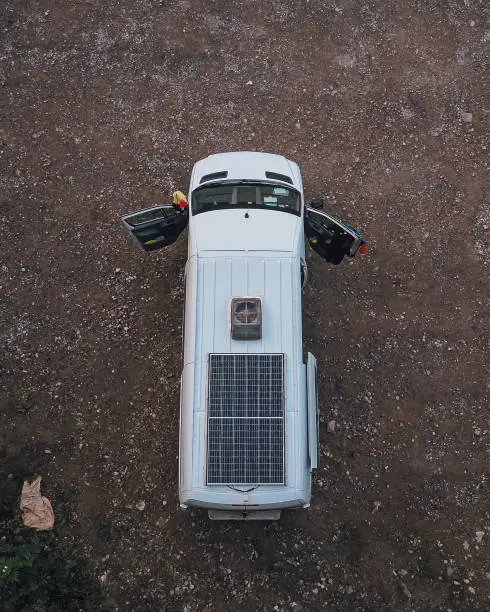
Rigid panels are the most common choice for van roofs. They are highly efficient, durable, and typically available from 100 to 400W per panel. They can be glued or bolted directly to the roof.
Flexible panels can curve to fit a rounded roofline. They are lighter but generally less efficient and have a shorter lifespan. They work well on vans with curved roofs where rigid panels will not sit flat.
Foldable and portable panels can be set up outside the van and angled directly toward the sun. They are useful for winter parking or shaded spots and can be packed away when not needed.
For most van builds in Canada, rigid panels mounted on the roof are the standard and most reliable choice.
Alternator Charging While Driving
Your van’s alternator charges your starter battery while you drive. With a DC-DC charger, also called a battery-to-battery charger or B2B charger, you can also charge your house battery bank while driving.
A DC-DC charger takes power from your alternator, converts it to the right voltage and current for your house battery, and charges your house bank safely without straining the alternator.
Popular options include the Victron Orion-Tr Smart, the Renogy DC-DC Charger, and the Redarc BCDC. A 30A DC-DC charger driving for 3 hours adds about 90Ah to your battery, which is enough to significantly offset cloudy days or heavy usage.
This is one of the most underrated additions to any van power system. It effectively turns every drive into a charging session, which makes a real difference during Canadian winters when solar output drops.
Shore Power
Shore power means plugging your van into a regular AC outlet at a campground, a friend’s house, a parking garage, or a workplace.
An AC-to-DC converter or battery charger lets you charge your house battery from shore power. Many van lifers include this as a backup option. The Victron Multiplus combines an inverter and shore power charger in one unit, which is a popular choice for serious builds.
Shore power is most useful as a backup during extended cloudy periods in winter, before heading into a remote area, or when you are parked in a city for a stretch of time.
Wind Power
Small wind turbines exist for van use but are not commonly used. They are noisy, have moving parts that wear out, and most van parking spots do not have consistent enough wind to make them worthwhile. Solar and alternator charging cover the needs of most van lifers without the added complexity.
Putting Together a Resilient Off-Grid Van Power System
The most reliable van power systems combine multiple charging sources. Here is the ideal setup for Canadian van life.
For your primary source, use 300 to 400W of roof-mounted solar panels with an MPPT charge controller. This handles most days from spring through fall across Canada.
For your secondary source, add a 30 to 40A DC-DC charger pulling from the alternator while driving. This fills the gaps on cloudy days and winter trips when solar falls short.
For your tertiary source, include a shore power charger for extended city stays or long winter stretches when you have access to an outlet.
For storage, use 100 to 200Ah of lithium batteries with a quality BMS and Bluetooth monitoring so you always know your state of charge.
For output, a 1,000 to 2,000W pure sine wave inverter handles all your AC devices comfortably.
For monitoring, a Victron BMV-712 or SmartShunt gives you real-time data on everything flowing in and out of your system.
With this kind of layered off-grid van power system, you can handle almost anything Canada throws at you, whether that is cloudy weeks in the BC Interior, long winter nights on the Prairies, or rainy summer weeks on the Atlantic coast.
The Mindset Shift: Thinking in Energy
Living off grid van power system changes how you think about electricity. At home, you never think twice about plugging something in. In a van, every device has a cost measured in watt-hours and translated into sunny hours needed to replace what you used.
This is not a burden. It is actually freeing. You become aware of energy as a resource and you find yourself using only what you need. You notice when clouds roll in and mentally adjust your usage. You feel real satisfaction when your battery monitor shows 100 percent at noon on a sunny day somewhere in the Canadian Rockies.
Many van lifers say that managing their own power system is one of the most satisfying parts of van life. You are in control. You understand your system. And when you are parked somewhere beautiful, completely off the grid, running entirely on sunshine, that feeling is genuinely hard to beat.
Frequently Asked Questions
What size battery bank do I need for van life in Canada?
For most van lifers running a fridge, laptop, and basic devices, a 200Ah lithium battery bank is a solid starting point. If you work remotely or travel with a partner, moving up to 300 to 400Ah gives you a comfortable buffer for cloudy days and short winter sun hours across Canada.
Do I need a battery monitor for my van power system?
Yes, a battery monitor is one of the most important investments in any off-grid van power system. Without one you are guessing at your state of charge. The Victron BMV-712 and Victron SmartShunt are both excellent options that give you real-time data and peace of mind.
Can I run a fridge off solar in a Canadian winter?
Yes, but you need to plan carefully. A 12V compressor fridge is one of the biggest power consumers in a van. In winter, when peak sun hours drop to 2 to 3 hours per day in most of Canada, you will need a solid battery bank, an MPPT charge controller, and ideally a DC-DC charger pulling from your alternator while driving to keep up with the fridge’s demand.
What is the difference between parallel and series battery wiring?
Parallel wiring keeps your voltage the same and increases your capacity. Series wiring keeps your capacity the same and increases your voltage. Most Canadian van builds use parallel 12V wiring to build a larger battery bank. If you are building a 24V system for a bigger inverter setup, you would wire batteries in series.
Is solar enough on its own for van life in Canada?
For most of the year from spring through fall, solar covers the majority of your power needs. In winter, especially in northern provinces, shorter days and lower sun angles reduce solar output significantly. Adding a DC-DC charger for alternator charging while driving makes your system much more resilient year round. The Canadian Renewable Energy Association offers useful resources on renewable energy systems if you want to learn more about optimizing your setup for Canadian conditions.
Where can I learn about electrical safety standards for van builds in Canada?
If you want to make sure your van electrical system meets Canadian safety standards, the Electrical Safety Authority is a reliable resource for understanding the regulations that apply to vehicle-based electrical builds, particularly in Ontario. It is worth reviewing before you finalize your wiring plan.